
Enhancing LLM Production Reliability & Observability
Learn how to improve LLM production reliability through observability, monitoring, performance tracking, error detection, and scalable AI infrastructure.
 Hassan SiddiqueOctober 30, 2026
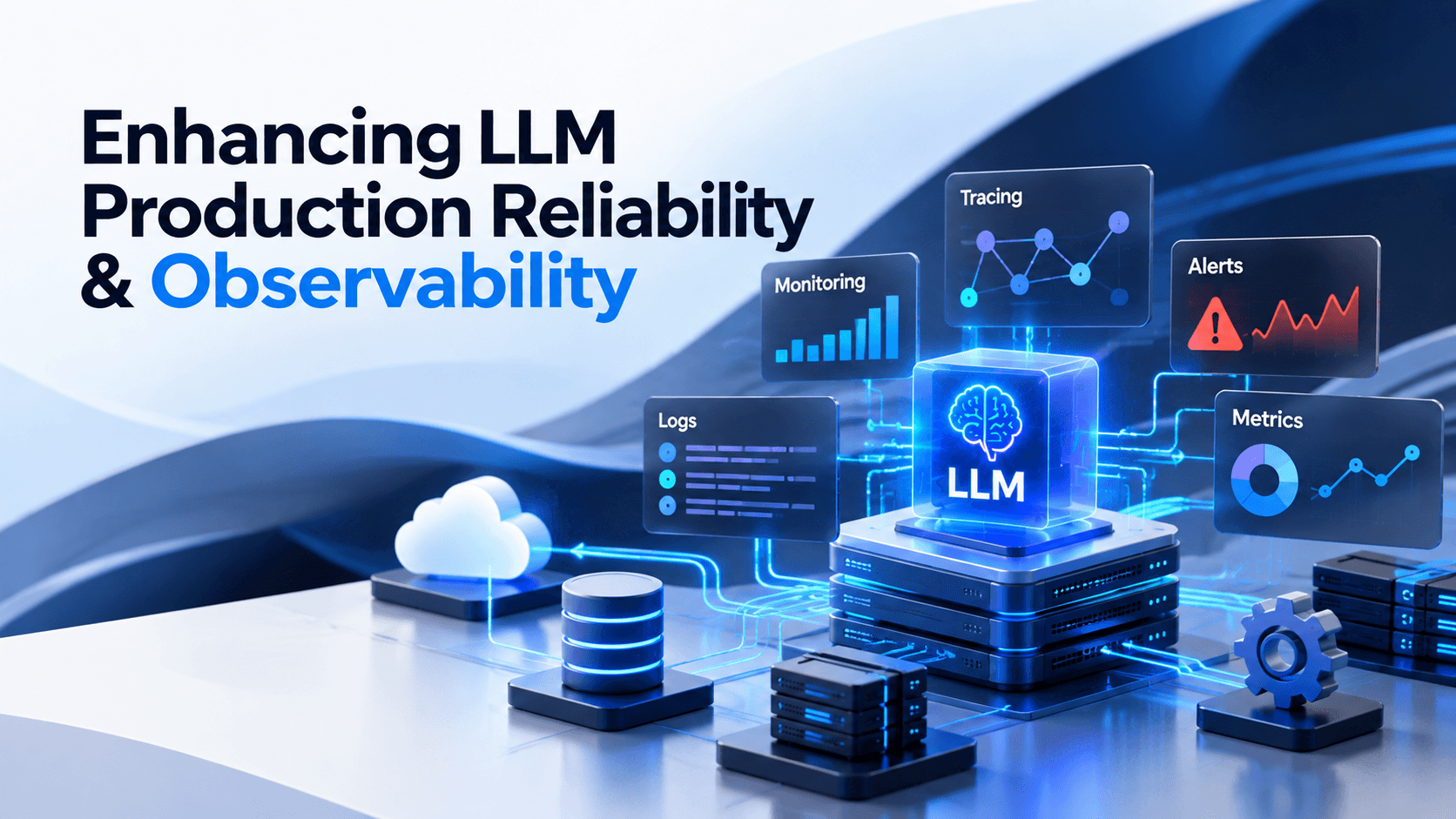
Understanding LLM Production Reliability and Observability
Deploying a Large Language Model (LLM) into production involves more than selecting a capable model and connecting it to an application. Once real users begin interacting with an AI system, businesses must ensure that responses remain accurate, performance stays consistent, and services remain available under varying workloads.
LLM production reliability focuses on keeping AI applications stable, responsive, and dependable. This includes managing service availability, controlling response times, handling failures, maintaining consistent output quality, and ensuring that the system can scale as usage increases.
Observability provides the visibility needed to understand how an LLM application behaves internally. By collecting and analyzing logs, metrics, and traces, engineering teams can identify performance bottlenecks, investigate unexpected responses, and understand how requests move through different components of an AI system.
Unlike traditional applications, LLM-powered systems introduce additional variables, including model response variability, token consumption, prompt complexity, retrieval quality, and inference performance. These factors make dedicated monitoring and observability essential for operating AI applications reliably.
Key areas of LLM production reliability include:
- Availability: Ensuring AI services remain accessible and recover gracefully from failures.
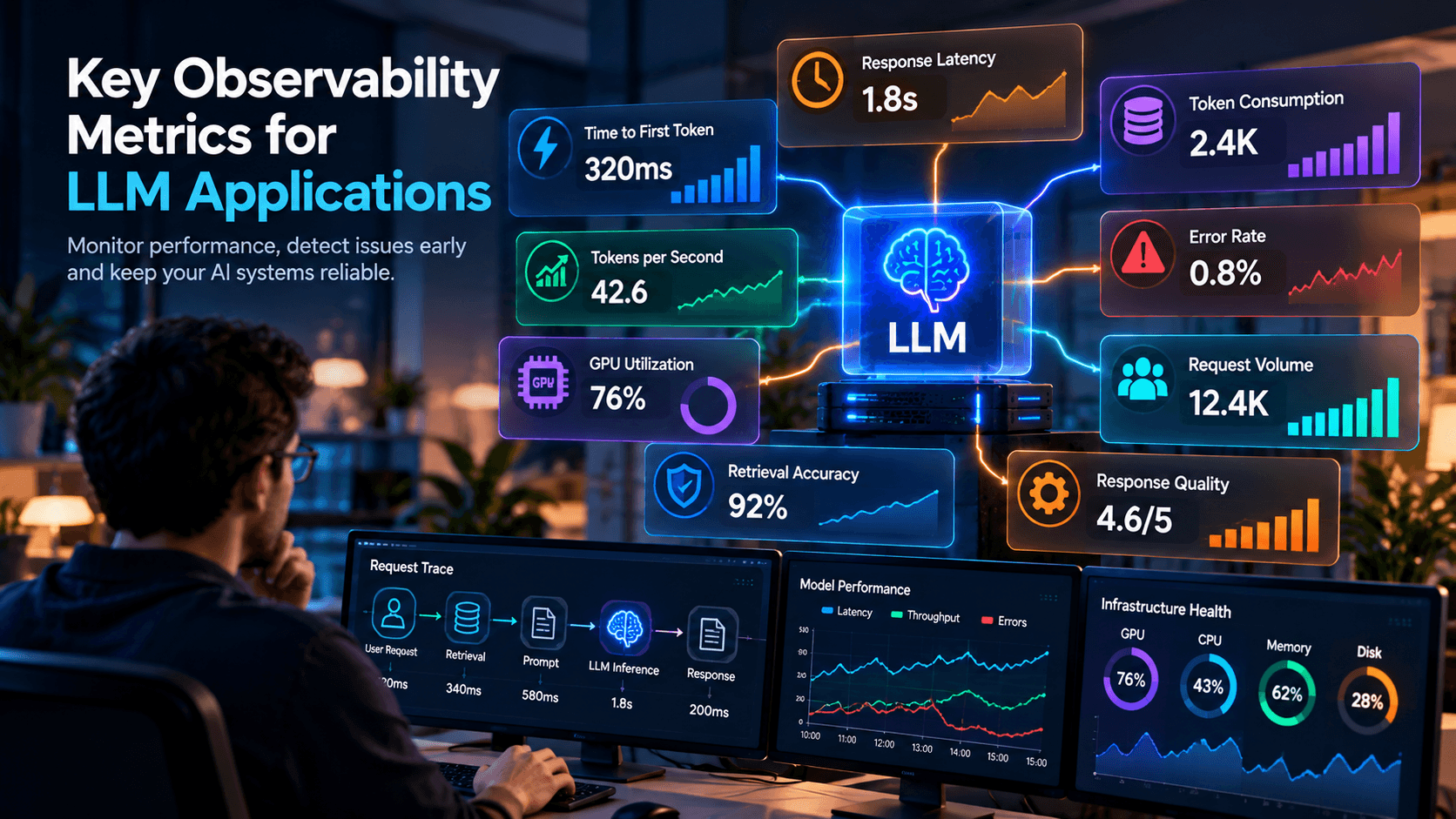
- Latency: Monitoring response times and reducing delays during inference.
- Response Quality: Evaluating relevance, accuracy, and consistency of generated outputs.
- Resource Utilization: Tracking GPU, CPU, memory, and token consumption.
- Error Management: Detecting model failures, API errors, and retrieval issues.
- Scalability: Maintaining stable performance as concurrent users and workloads increase.
Essential Observability Metrics for LLM Applications
Effective LLM observability requires monitoring more than traditional application metrics. While CPU usage, memory consumption, and API availability remain important, AI applications also need visibility into model-specific behavior and response quality.
Tracking the right metrics helps engineering teams understand whether performance issues originate from the application, model inference layer, retrieval system, or external services.
Monitoring, Logging and Tracing Across the LLM Stack
An LLM application typically consists of multiple connected components, including frontend applications, APIs, prompt-processing services, retrieval systems, model providers, vector databases, and infrastructure services. A failure in any of these components can affect the overall user experience.
Monitoring helps teams identify when something goes wrong, logging provides the detailed information needed to investigate it, and distributed tracing shows how individual requests travel across the system.
For example, when a user submits a question to a RAG-based application, the request may pass through authentication, API processing, document retrieval, prompt construction, model inference, and response formatting. Without end-to-end visibility, identifying the source of a delay or failure can become difficult.
ExpertsCloud
How ExpertsCloud Helps Businesses Build Reliable AI Systems
At ExpertsCloud, we help businesses build production-ready AI applications with a focus on reliability, performance, security, and scalability. Our team works on LLM integrations, AI-powered applications, scalable backend architectures, AWS infrastructure, monitoring, and automated deployment workflows.
We focus on the complete AI ecosystem from model integration and API performance to infrastructure monitoring, error handling, and application scalability. This helps businesses move beyond AI experimentation and operate dependable AI solutions in real-world environments.
Related Case Study: Automated AWS Infrastructure & Observability
Explore how ExpertsCloud modernized CareCapture and TulioHealth's AWS infrastructure with automated deployments, security controls, centralized monitoring, and improved operational visibility.
Read the Case Study → https://www.theexpertscloud.com/case-studies/carecapture