
Local LLM Deployment 2026: Throughput Barriers
Explore the key challenges of local LLM deployment in 2026, including throughput limitations, hardware requirements, inference performance, scalability, latency, and strategies for building efficient AI infrastructure.
 Tariq SajidSeptember 24, 2026
Understanding Local LLM Deployment in 2026
Local LLM deployment allows organizations to run language models within infrastructure they control rather than relying entirely on externally hosted AI APIs. This approach can provide greater control over data, model execution, infrastructure configuration, and application architecture.
However, deploying an LLM locally involves significantly more than downloading a model and running inference. Organizations need to consider the model's memory requirements, GPU capacity, inference engine, context length, concurrent users, request volume, latency expectations, and overall infrastructure design.
As AI applications move from experimentation toward production, these requirements become increasingly important. A model that performs well for a single developer may behave very differently when it needs to serve many simultaneous requests.
Key Local LLM Deployment Considerations
| Factor | Why It Matters |
|---|---|
| Model size | Determines memory and compute requirements |
| GPU memory | Limits which models can run efficiently |
| Throughput | Determines how many requests can be processed |
| Latency | Directly affects user experience |
| Concurrent users | Determines infrastructure capacity |
| Context length | Influences memory and processing requirements |
| Quantization | Can reduce model memory requirements |
| Inference engine | Influences serving performance |
The Biggest Barrier: LLM Throughput
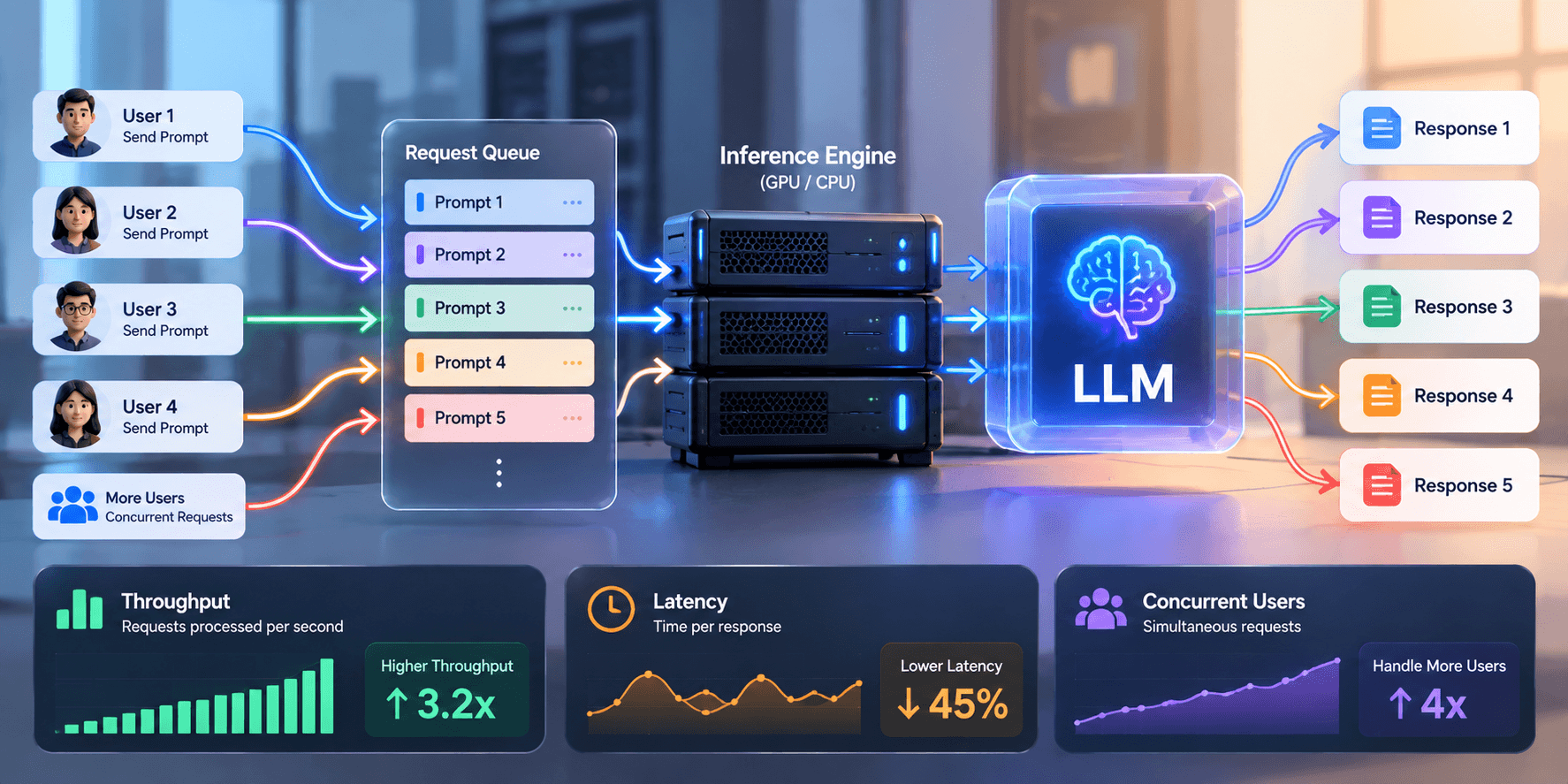
Throughput is one of the most important challenges when moving local LLMs from experimentation into production.
For a single user, response speed may appear sufficient. Once multiple users send requests simultaneously, however, the available compute resources must be shared between those requests. This can increase latency and reduce the number of requests that the system can process efficiently.
Throughput is influenced by several factors, including model size, hardware configuration, prompt length, output length, context size, batching strategy, inference engine, and the number of concurrent requests.
Hardware, Memory and Scaling Barriers
Hardware is another major consideration when deploying LLMs locally.
Modern language models can require substantial GPU memory, particularly when organizations want to run larger models, support long context windows, or handle multiple concurrent requests.
GPU memory is therefore not simply a hardware specification it can become a practical limit on the size of the model, number of simultaneous requests, and overall serving configuration.
Organizations can use techniques such as quantization, model optimization, batching and efficient inference engines to reduce resource requirements and improve utilization.
Overcoming Local LLM Deployment Barriers
The solution to local LLM performance problems is not always to purchase more powerful hardware.
Organizations can often improve efficiency by optimizing the complete AI stack.
Model Optimization
Using a smaller model can reduce memory consumption and inference requirements when the smaller model still provides sufficient quality for the workload.
Quantization can also reduce memory requirements and make certain models practical on more accessible hardware.
Inference Optimization
The inference layer can be optimized through efficient serving engines, batching, scheduling, caching and appropriate concurrency configuration.
The goal is to ensure that available compute resources are used efficiently instead of remaining underutilized.
Application Optimization
The application itself can also create unnecessary workload.
For example, sending unnecessarily large prompts or retrieving excessive context can increase processing requirements. A well-designed RAG system can retrieve only relevant information before sending the request to the LLM.
Caching can also prevent identical or frequently repeated requests from unnecessarily consuming inference resources.
Workload-Based Model Selection
Not every task requires the same model.
ExpertsCloud
How ExpertsCloud Helps Businesses Overcome Local LLM Deployment Barriers
At ExpertsCloud, we help businesses design AI infrastructure around real-world requirements such as throughput, latency, GPU utilization, scalability, privacy, and production reliability.
Our team works with LLM applications, RAG systems, AI agents, model integrations, inference infrastructure, and AWS-based AI architectures, helping organizations optimize the complete AI stack rather than focusing only on the model.
Whether the requirement is a private AI environment, a high-throughput inference platform, or a hybrid architecture, ExpertsCloud can help design and deploy an AI solution that is aligned with the application's workload and growth requirements.
Related Case Study: AI-Driven Knowledge Management & Virtual Assistance
Explore how ExpertsCloud built an AI-powered platform focused on real-time knowledge retrieval, context-aware responses, and scalable multi-user interactions.
Read the Case Study →