
Local LLM Strategies for 2026: Achieving Optimal Throughput and Privacy
Local LLM strategies for 2026, covering AI model throughput, privacy, infrastructure, deployment options, and how businesses can run powerful language models locally.
 Nadir HussainSeptember 16, 2026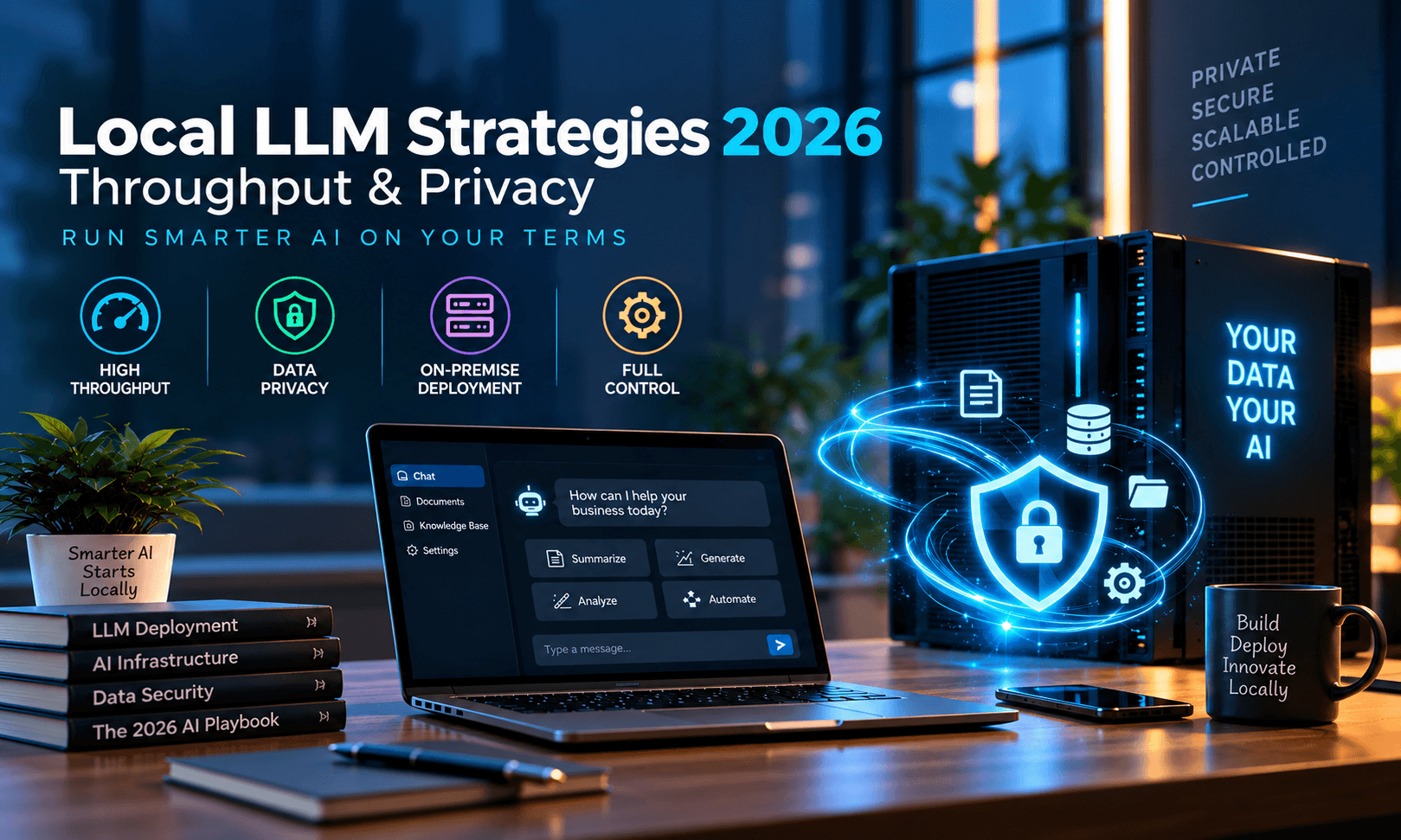
Local LLMs in 2026: Why Businesses Are Moving AI Closer to Their Data
Local Large Language Models (LLMs) are becoming an important part of enterprise AI strategies in 2026. Instead of relying entirely on cloud-hosted AI APIs, organizations can deploy language models within their own infrastructure, private cloud environments, edge systems, or dedicated servers. This gives businesses greater control over how AI workloads operate and, importantly, where their data is processed.
One of the main reasons organizations consider local LLMs is data control. With a traditional hosted AI service, information is sent to an external service for inference. A locally deployed model can process prompts, documents, and other information within infrastructure controlled by the organization. This can be particularly valuable for companies working with confidential business information, internal documentation, intellectual property, customer information, or other sensitive datasets.
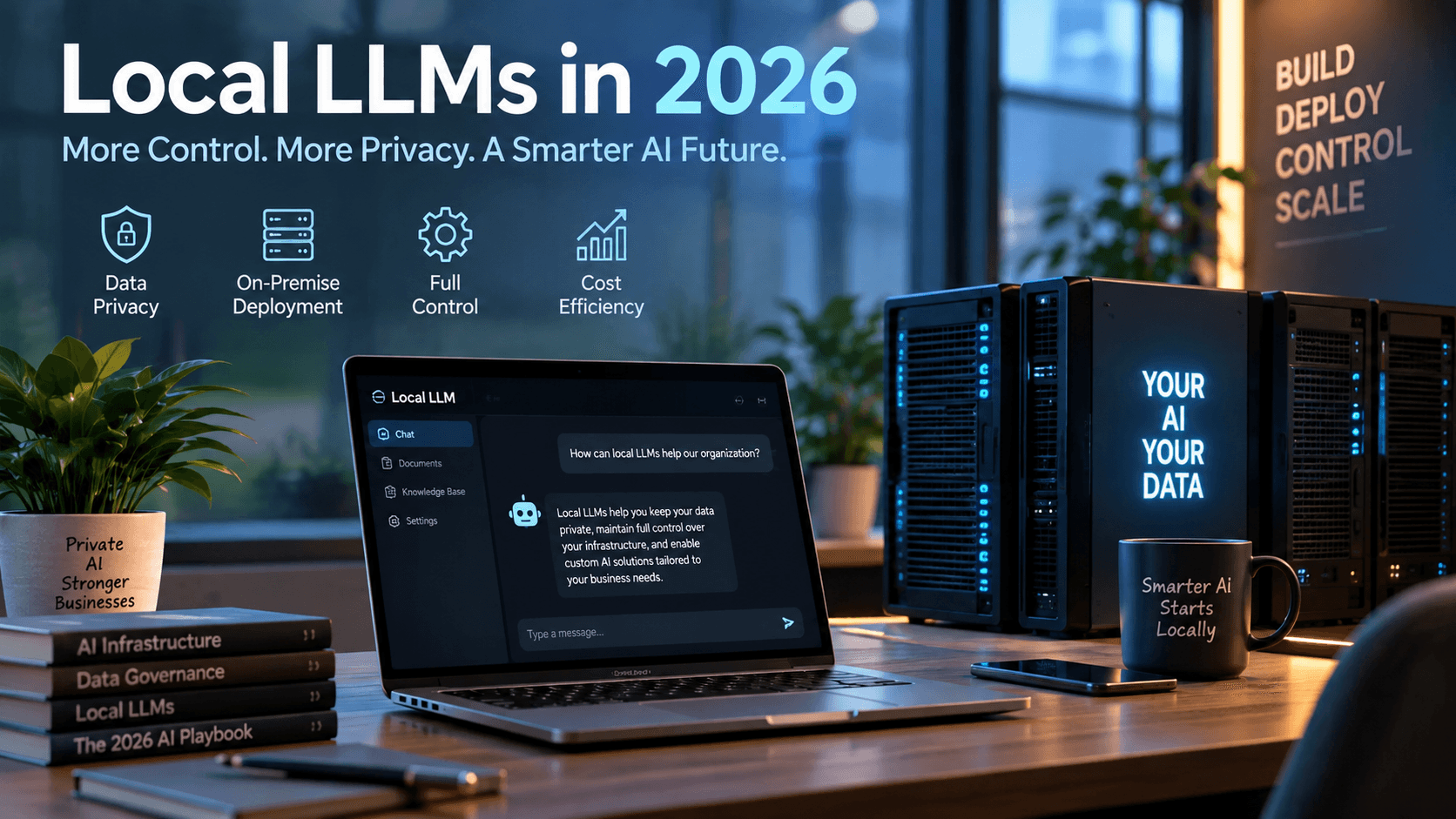
Local deployment can also provide organizations with greater control over the AI environment itself. Teams can decide which models to deploy, how much computing capacity to allocate, what security controls should surround the system, and how the model should integrate with existing applications and internal data sources.
However, moving an LLM locally does not automatically produce a faster or cheaper AI system. Organizations become responsible for infrastructure sizing, GPU resources, model optimization, monitoring, scaling, updates, and availability. As a result, the decision between local and cloud-based LLMs increasingly depends on the workload rather than a simple preference for one deployment model.
The key challenge for businesses in 2026 is therefore finding the right balance between performance, privacy, infrastructure requirements, scalability, and operational cost.
Throughput and Performance: Building an Efficient Local LLM Environment
Throughput is one of the most important considerations when evaluating a local LLM deployment. In practical terms, organizations need to understand how much AI workload their infrastructure can process while still providing an acceptable experience to users.
Several factors influence local LLM performance, including the size of the model, available GPU memory, hardware architecture, context length, number of simultaneous users, inference configuration, and model optimization techniques.
A larger model may provide stronger capabilities for complex tasks, but it generally requires more computational resources. Smaller or optimized models can often operate with fewer resources and may provide better responsiveness for focused applications. Organizations therefore need to select models according to the actual business workload rather than assuming that the largest available model will always be the most appropriate choice.
Concurrency is another important consideration. An AI application serving one internal user has very different infrastructure requirements from a customer-facing assistant handling many simultaneous conversations. As concurrent requests increase, organizations need sufficient compute resources and an inference architecture capable of efficiently managing those requests.
Context length can also influence resource consumption. Applications that continuously send large documents or extensive conversation histories to an LLM can require significantly more memory and compute than applications processing shorter prompts.
Privacy and Data Control: The Strongest Case for Local LLMs
Privacy is one of the strongest reasons organizations consider local LLM deployments.
When an application uses an external AI API, information must generally leave the application's immediate environment for processing. Depending on the application, prompts may contain customer information, internal documents, proprietary business knowledge, code, contracts, research, operational data, or other sensitive material.
A local deployment provides the option to keep inference within infrastructure controlled by the organization.
This does not mean that a local LLM is automatically secure. Security depends on the complete architecture surrounding the model.
Organizations still need authentication, authorization, encryption, network controls, monitoring, logging policies, secure storage, patch management, and appropriate access controls.
Privacy Considerations
A production local LLM strategy should consider several layers of data protection.
Data ingestion:
Organizations should understand what information is entering the AI system. Applications should avoid providing unnecessary sensitive information to a model.
Prompt processing:
Prompts can contain confidential information. Appropriate controls should determine who can submit information and which systems can access it.
Model responses:
Generated responses can unintentionally expose information available within the model's context or connected knowledge sources. Authorization should therefore apply not only to the application but also to the underlying data.
Conversation history:
Applications should determine whether conversations need to be stored at all. Where storage is necessary, retention periods and access policies should be clearly defined.
Knowledge bases:
If the LLM uses Retrieval-Augmented Generation, access to documents should follow the permissions of the underlying organization. A user should not gain access to restricted information simply because it has been indexed by an AI system.
Logs and monitoring:
Application and inference logs can themselves contain sensitive prompts and responses. Logging strategies should therefore balance observability with privacy.
Building a Practical Local LLM Strategy for 2026
Organizations considering local AI should avoid beginning with hardware procurement or selecting a model based purely on benchmark rankings. The process should begin with the business workload.
The first question should be: What does the AI system actually need to do?
A document summarization application has different requirements from a coding assistant. A chatbot serving five internal employees has different infrastructure requirements from an AI assistant serving thousands of customers.
Organizations should therefore define expected users, request volumes, latency requirements, privacy requirements, context sizes, quality expectations and integration requirements before choosing infrastructure.
Step 1: Identify the Workload
Determine the primary tasks the model will perform.
These might include summarization, question answering, document extraction, content generation, classification, coding assistance, enterprise search, customer support, or AI agent workflows.
The workload determines how capable the model needs to be.
Step 2: Define Privacy Requirements
Determine what information will enter the system and where that information is allowed to be processed.
Highly sensitive workloads may justify completely isolated inference, while other applications may support a hybrid architecture.
Step 3: Select the Appropriate Model
Evaluate models based on the actual workload rather than model size alone.
Important considerations include:
- Response quality
- Model size
- Memory requirements
- Context window
- Inference performance
- Licensing
- Tool-calling capabilities
- Structured output support
- Multilingual requirements
- Fine-tuning or customization requirements
A smaller model that performs a specific task reliably can be more operationally efficient than a much larger general-purpose model.
Step 4: Benchmark with Real Workloads
Generic benchmarks are useful for initial comparisons, but production decisions should be validated against real organizational prompts and documents.
Testing should measure response quality, first-token latency, generation speed, concurrent request handling, memory consumption, GPU utilization, failure rates and overall application latency.
Step 5: Optimize Before Scaling Hardware
When performance is insufficient, purchasing additional hardware should not always be the first response.
Organizations can first evaluate:
- Quantization
- Prompt optimization
- Context reduction
- Semantic caching
- Request batching
- Retrieval optimization
- Model routing
- Smaller specialized models
- Efficient inference engines
These techniques can reduce infrastructure requirements while maintaining acceptable application quality.
Step 6: Decide Between Local, Cloud and Hybrid AI
The final architecture does not need to use only one deployment model.
ExpertsCloud
How ExpertsCloud Helps Businesses Build Private AI Solutions
At ExpertsCloud, we help businesses design and implement AI solutions that balance performance, privacy, scalability, and infrastructure requirements. We work with local, private, and hybrid LLM architectures to help organizations choose the right approach for their specific AI workloads.
Our team can help with LLM deployment, AI infrastructure, RAG-based applications, model optimization, AI agents, and secure enterprise AI solutions, enabling businesses to use their data and AI capabilities more efficiently while maintaining greater control over sensitive information.
Whether you need a fully private AI environment or a hybrid architecture combining local and cloud-based models, ExpertsCloud can help you design, build, and deploy the solution around your business requirements.
See how ExpertsCloud applied secure AI architecture, knowledge bases, document processing, and intelligent information retrieval to build an AI-powered healthcare solution.
Read the Case Study →
https://www.theexpertscloud.com/case-studies/ai-multi-tenant-healthcare-chatbot/