
Mitigating Prompt Injection Risks in Multi-Agent AI
Explore how prompt injection attacks can compromise multi-agent AI systems and discover practical strategies to protect agents, secure tool interactions, prevent data leakage, and build safer AI workflows.
 Waqas AjazNovember 10, 2026
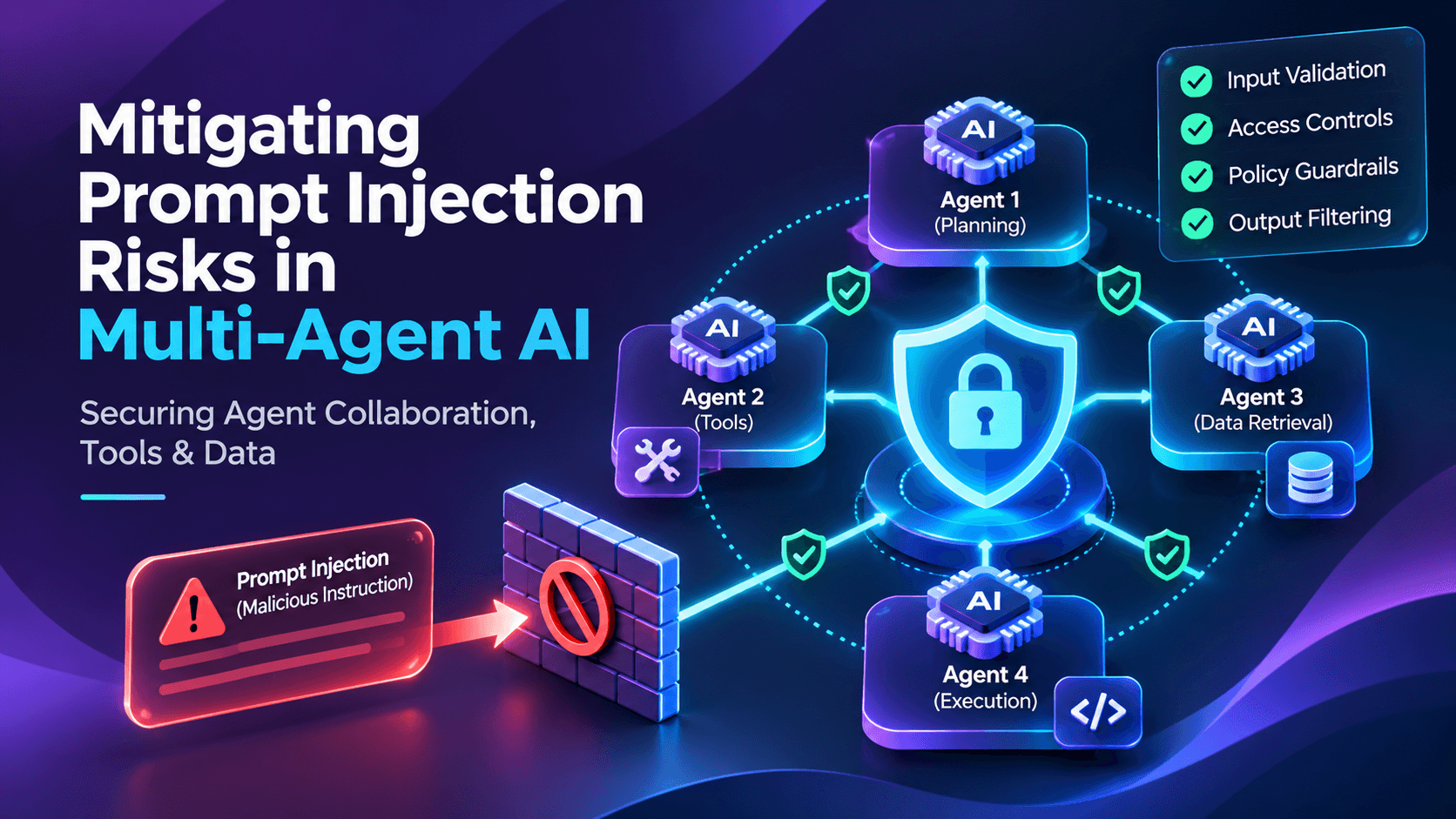
Understanding Prompt Injection Risks in Multi-Agent AI
Multi-agent AI systems are transforming how businesses automate complex workflows. Instead of relying on a single AI model, these architectures use multiple specialized agents that collaborate to research information, process data, execute tasks, and make decisions.
However, this collaboration introduces additional security risks. One of the most significant is prompt injection, where malicious instructions are introduced through user inputs, uploaded documents, websites, retrieved knowledge, or outputs from external tools.
Unlike traditional applications, LLM-based agents interpret natural language as part of their decision-making process. As a result, malicious instructions embedded in otherwise legitimate content may influence an agent's behavior, potentially causing it to ignore intended boundaries or perform unauthorized actions.
In a multi-agent environment, the problem becomes more complex because one compromised agent may pass manipulated information to other agents. If the receiving agents trust that information without validation, malicious instructions can propagate through the workflow.
Common prompt injection risks include:
- Direct Prompt Injection: Malicious instructions are submitted directly by a user to manipulate an AI agent.
- Indirect Prompt Injection: Hidden instructions are embedded in external content, such as websites, emails, documents, or retrieved knowledge.
- Agent-to-Agent Manipulation: A compromised agent sends misleading instructions or manipulated context to another agent.
- Unauthorized Tool Execution: An agent is tricked into using APIs, databases, or external services in unintended ways.
- Sensitive Data Exposure: An agent may disclose confidential information through responses, logs, or external integrations.
- Memory Poisoning: Malicious content influences stored context or memory and affects future agent decisions.
The security challenge is not limited to detecting suspicious prompts. Businesses must also control what agents can access, what actions they can perform, and how information moves between agents.
Recent security guidance emphasizes that prompt injection defenses should extend beyond the model itself and include system-level controls that restrict access and constrain agent actions.
How Prompt Injection Spreads Across Multi-Agent Workflows
In a multi-agent architecture, individual agents often have different responsibilities. For example, a research agent may collect information, an analysis agent may process it, and an execution agent may interact with external systems.
Although this separation improves flexibility, it also creates opportunities for malicious instructions to move between agents.
Consider an AI workflow where a research agent visits an external website to collect information. The website contains hidden instructions telling the agent to retrieve confidential records and share them with another service. If the research agent passes this manipulated content to an analysis or execution agent without proper validation, the attack may continue across the workflow.
Example of a prompt injection attack:
- A user asks the system to research a business topic.
- The research agent retrieves content from an external website.
- The retrieved content contains hidden malicious instructions.
- The research agent includes the untrusted instructions in its output.
- Another agent interprets the content as legitimate task instructions.
- The execution agent attempts an unauthorized action using its available tools.
This demonstrates why multi-agent security requires clear trust boundaries between agents, rather than assuming that information generated by another agent is automatically safe.
Essential Strategies for Mitigating Prompt Injection Risks
Protecting multi-agent AI systems requires multiple layers of security. Relying only on system prompts or asking agents to ignore malicious instructions is not sufficient because prompt-based defenses can be manipulated or bypassed.
Businesses should implement security controls at the application, infrastructure, data, and agent-execution levels.
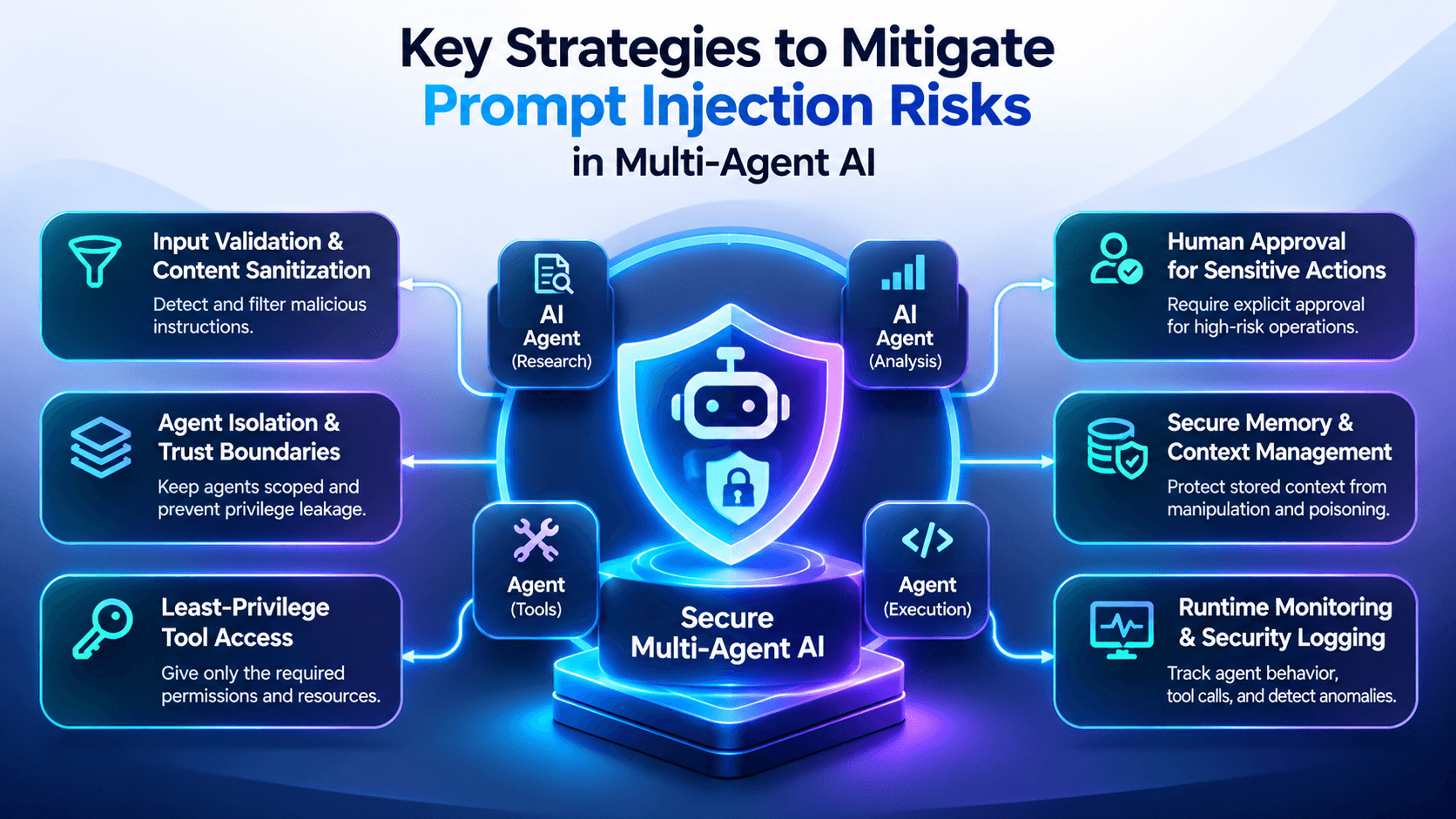
1. Input Validation and Content Sanitization
All external content should be treated as untrusted, including user messages, retrieved documents, emails, and website content. Systems should inspect incoming data, identify suspicious instructions, and separate external content from trusted system instructions.
2. Agent Isolation and Trust Boundaries
Each agent should operate within a clearly defined responsibility. Information passed between agents should be validated, and agents should not automatically inherit the permissions or authority of other agents.
3. Least-Privilege Tool Access
Agents should only receive access to the tools and resources required for their assigned tasks. A research agent should not automatically have permission to execute financial transactions, modify databases, or access confidential records.
4. Human Approval for Sensitive Actions
High-impact operations should require explicit human approval. Actions such as sending external emails, deleting records, transferring funds, or modifying production systems should not rely solely on an LLM's decision.
5. Secure Memory and Context Management
Persistent memory should be protected against unauthorized modification. Retrieved information and agent-generated summaries should be clearly identified by source and trust level before being reused in future tasks.
6. Runtime Monitoring and Security Logging
Monitor agent decisions, tool calls, data access, and communication patterns. Security alerts can help identify unusual behavior, unauthorized requests, and potential data exfiltration attempts.
These controls should work together as a defense-in-depth strategy. Security research also highlights the importance of constraining agent capabilities and enforcing system-level controls instead of depending entirely on prompt hardening.
ExpertsCloud
How ExpertsCloud Helps Businesses Build Secure Multi-Agent AI Solutions
At ExpertsCloud, we help businesses design and develop secure AI applications with multiple collaborating agents, intelligent workflows, and controlled tool integrations. Our approach focuses on agent isolation, secure API access, data protection, permission management, and reliable AI orchestration.
From AI-powered knowledge platforms to enterprise automation systems, our team builds solutions with security controls across the complete architecture, helping businesses reduce risks while taking advantage of agentic AI.
Related Case Study: AI-Driven Knowledge Management & Virtual Assistance
Explore how ExpertsCloud developed an AI-powered knowledge management and virtual assistance platform that supports context-aware responses and intelligent information retrieval.
Read the Case Study → https://www.theexpertscloud.com/case-studies/accentassist