
vLLM vs Ollama: Local LLM Efficiency in 2026
A practical 2026 guide to evaluating local LLM efficiency with vLLM and Ollama, comparing performance, deployment, scalability, hardware requirements, privacy, and the right use cases for each approach.
 Hassan SiddiqueSeptember 17, 2026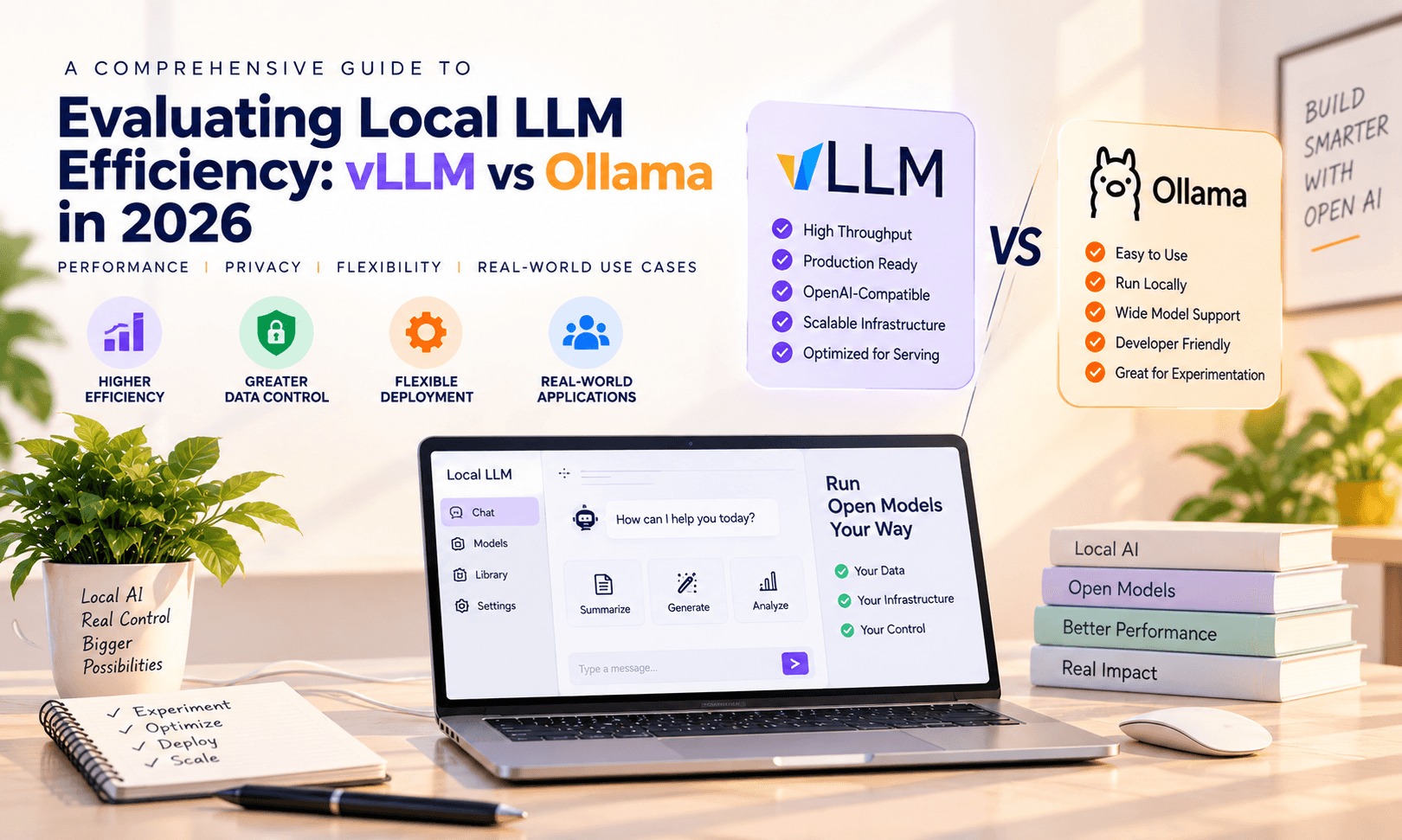
Understanding vLLM and Ollama for Local LLM Deployment
Running an LLM locally is no longer limited to experimentation on a developer's laptop. As open models become more capable, organizations are increasingly evaluating self-hosted inference for applications that require greater control over data, infrastructure, performance, and operating costs.
Two technologies that frequently appear in local LLM deployments are vLLM and Ollama. Although both can be used to run language models locally, they are designed around different priorities.
Ollama focuses heavily on making local model usage simple. Developers can download models, run them locally, and interact with them through a local API without having to build a complex inference-serving stack. Its ecosystem also supports integrations with development tools and applications. Ollama's current platform supports local models as well as cloud models, while its local API can be accessed without authentication on the local machine.
vLLM, on the other hand, is positioned as an inference and serving engine designed for fast LLM serving. It provides an HTTP server with OpenAI-compatible APIs and includes capabilities intended for production serving and scaling. Its serving ecosystem also supports deployment patterns ranging from a single GPU to multi-node environments through Ray Serve LLM.
The distinction becomes important when choosing an architecture. A developer experimenting with a model locally may prioritize simplicity and quick setup, while a business serving an AI application to many concurrent users may place greater emphasis on throughput, request scheduling, observability, and scaling.
vLLM vs Ollama at a Glance
| Factor | vLLM | Ollama |
|---|---|---|
| Primary focus | High-performance inference and serving | Simple local model execution |
| Local development | Supported | Strong focus |
| Production serving | Strong focus | Can be used, depending on architecture |
| API | OpenAI-compatible APIs | Local API and integrations |
| Scaling | Supports production scaling patterns | Local-first experience with cloud options |
Evaluating Local LLM Efficiency: Throughput, Latency and Resource Usage
The performance of a local LLM cannot be measured using a single number.
For practical deployments, organizations should evaluate several metrics, including time to first token, tokens per second, total request latency, concurrent request capacity, GPU utilization, memory consumption, and overall throughput.
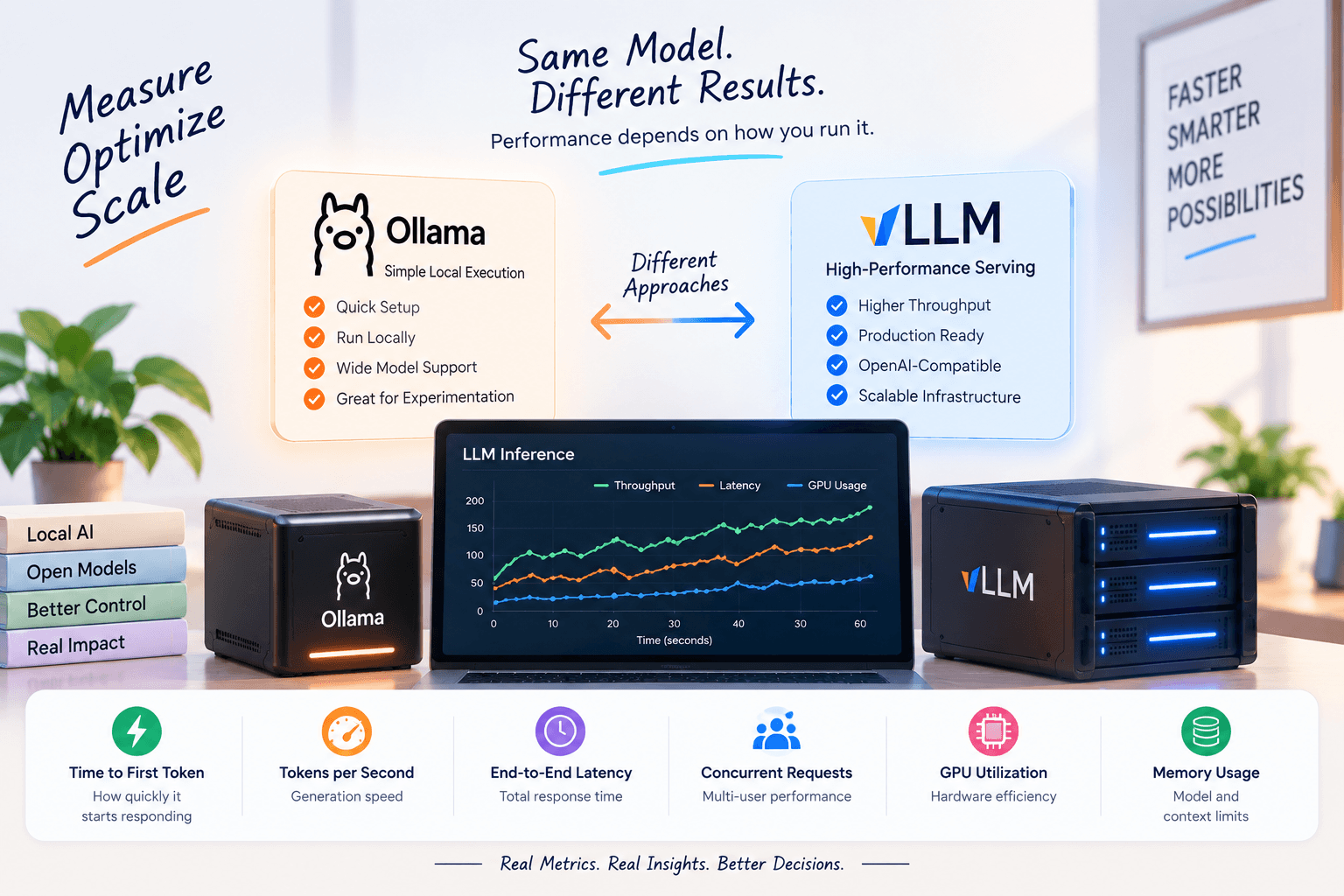
Throughput becomes particularly important when an AI system needs to serve multiple users simultaneously. A model that feels fast for a single developer may behave differently when many requests arrive at the same time.
This is one of the areas where an inference-serving engine such as vLLM becomes particularly relevant. vLLM is designed around efficient LLM serving and describes itself as providing state-of-the-art serving throughput. Its serving layer exposes OpenAI-compatible APIs and can be extended through Ray Serve LLM for autoscaling, load balancing, and back-pressure.
Ollama has also continued to improve performance and hardware support. For example, Ollama reported performance improvements in its 0.30 release, including up to 20% faster performance on NVIDIA hardware in its stated benchmark configuration, as well as broader GPU acceleration through Vulkan.
However, benchmark numbers should always be interpreted within their testing conditions. Model size, quantization, hardware, context length, prompt length, generation length, concurrency and inference configuration can all influence the results.
vLLM vs Ollama: Choosing the Right Architecture
The biggest difference between vLLM and Ollama is not simply speed. It is the type of problem each tool is trying to make easier.
Ollama provides a straightforward experience for running open models locally. This makes it particularly useful during development, experimentation, prototyping, internal tools, and applications where simplicity is an important requirement.
Ollama's ecosystem has also expanded beyond basic local model execution. Its 2026 updates include integrations with coding tools, MLX-based improvements on Apple Silicon, GGUF support through llama.cpp, and support for running models across local and cloud environments.
vLLM is more focused on the serving layer. It provides an HTTP server with APIs compatible with commonly used interfaces, including OpenAI-compatible completion and chat endpoints. It also supports embeddings and other serving interfaces, while Ray Serve LLM can provide autoscaling, load balancing and multi-node deployment capabilities.
That makes architecture an important part of the decision.
When Ollama Can Be a Good Fit
Ollama can be useful when the primary requirement is to:
- Run open models locally
- Quickly test different models
- Build a proof of concept
- Develop AI applications locally
- Keep development data on the local machine
- Build lightweight internal AI tools
- Experiment with coding assistants
- Integrate a local model through a simple API
The simplicity of the local workflow is one of its major advantages.
Building an Efficient Local LLM Stack in 2026
Selecting vLLM or Ollama is only one component of a complete local AI architecture.
A production-ready system typically includes several layers:
Application Layer → API Gateway → Authentication → LLM Inference → Retrieval/Knowledge Base → Monitoring → Storage
The inference engine should be selected based on what the application requires rather than being treated as the entire AI architecture.
For example, a private enterprise assistant might combine a local LLM with a vector database, document-processing pipeline and Retrieval-Augmented Generation architecture. In this setup, the LLM is responsible for generating responses while the retrieval layer provides relevant organizational information.
Performance optimization can also happen at multiple levels.
ExpertsCloud
How ExpertsCloud Helps Businesses Optimize Local LLM Deployments
At ExpertsCloud, we help businesses build efficient AI solutions by selecting the right combination of LLMs, inference infrastructure, APIs, and application architecture based on their performance, privacy, and scalability requirements.
Our team works on LLM applications, RAG systems, AI agents, knowledge platforms, and scalable AWS infrastructure, helping businesses move from local AI experimentation to reliable production-ready solutions.
Related Case Study: AI-Driven Knowledge Management & Virtual Assistance
Explore how ExpertsCloud built an AI-powered platform for real-time knowledge retrieval, context-aware responses, and scalable multi-user interactions.
Read the Case Study →
Accent Assist – AI-Driven Knowledge Management & Virtual Assistance View Case Study