
vLLM vs Ollama: Comparative Performance Analysis for Local LLM Deployments
Compare vLLM and Ollama for local LLM deployments, focusing on inference performance, throughput, latency, resource utilization, scalability, deployment complexity, and practical AI workloads.
 Waqas AjazOctober 2, 2026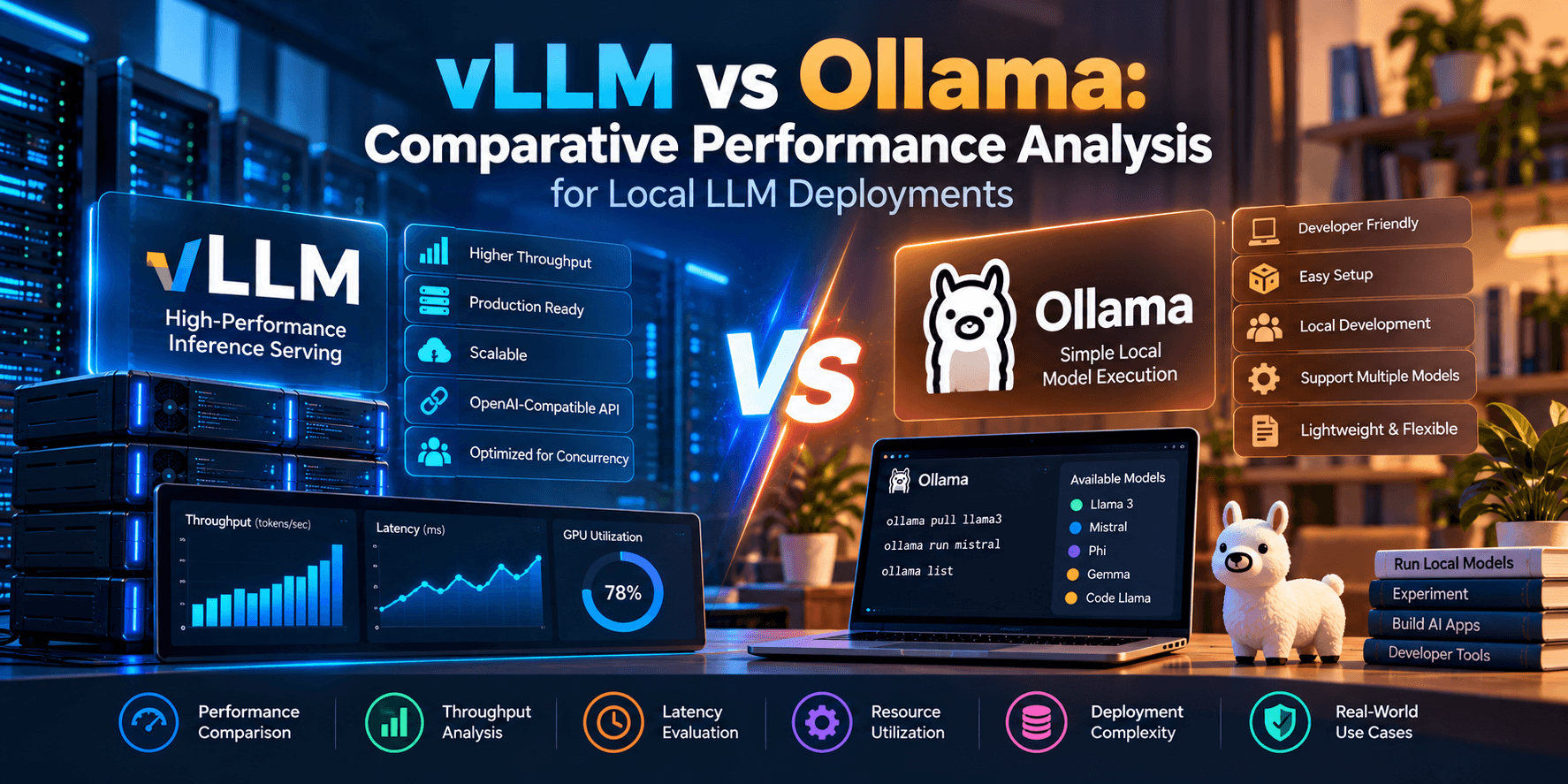
Understanding vLLM and Ollama for Local LLM Deployments
Local LLM deployment has become an increasingly practical approach for organizations that want greater control over AI workloads, data, infrastructure, and model execution. However, choosing the right inference framework can have a significant impact on the performance and scalability of the resulting application.
vLLM and Ollama are two widely used approaches for running open and local language models, but they target somewhat different deployment requirements.
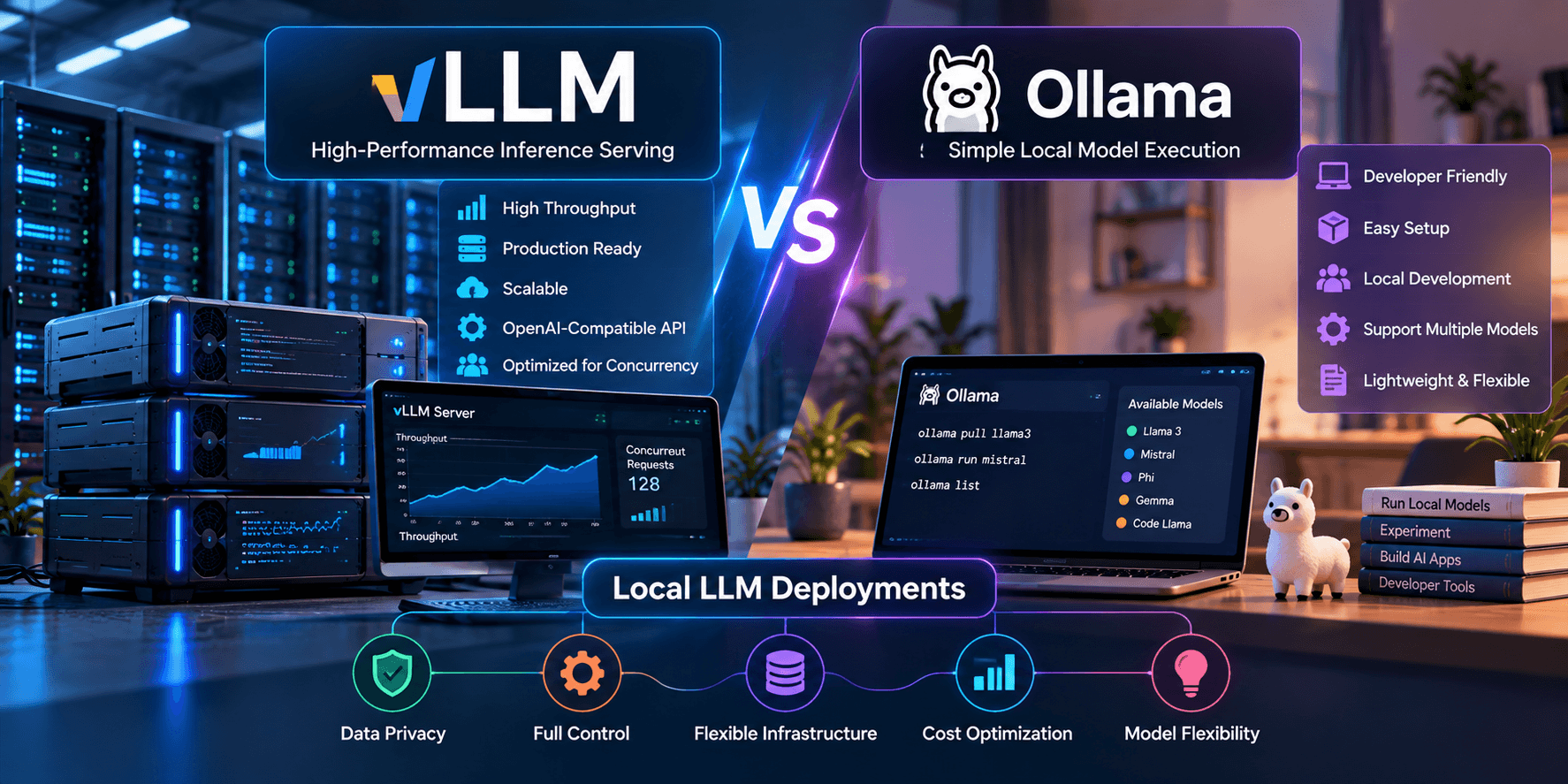
Ollama emphasizes a simple developer experience for running models locally, making it convenient for experimentation, development, prototyping, and lightweight AI applications. vLLM focuses more heavily on efficient inference serving and production-oriented workloads where throughput, concurrency, and scalable model serving are important.
The right choice therefore depends on the workload rather than simply comparing the two technologies as direct alternatives.
Comparing Inference Performance
Performance is one of the most important factors when evaluating a local LLM deployment.
A model that responds quickly to one request may behave differently when multiple requests arrive simultaneously. For this reason, performance analysis should consider more than just response time.
Important measurements include time to first token, tokens per second, end-to-end latency, throughput, concurrent requests, GPU utilization, and memory consumption.
Important Performance Metrics
| Metric | What It Measures |
|---|---|
| Time to First Token | How quickly the model begins generating |
| Tokens per Second | Generation speed |
| Request Latency | Total response time |
| Throughput | Requests or tokens processed over time |
| Concurrent Requests | Number of requests handled simultaneously |
Throughput, Latency and Resource Utilization
Throughput and latency are closely related but represent different aspects of an LLM system.
Latency measures how long a request takes to produce a response, while throughput measures how much work the system can process during a specific period.
For an individual developer, latency may be the most visible metric. For an enterprise AI platform serving many users, throughput and concurrency can become equally important.
A production system therefore needs to balance:
Response Speed + Throughput + Resource Utilization + Concurrency
Resource Utilization
Running an LLM locally requires careful management of available hardware.
GPU memory is particularly important because model weights, context and intermediate inference data all consume memory. Larger models and longer contexts can significantly increase resource requirements.
Optimization techniques such as quantization, batching, caching and efficient model serving can help improve resource utilization.
Which Approach Fits Different AI Workloads?
There is no single deployment strategy that fits every local LLM application.
A developer building an AI prototype may prioritize simplicity and fast setup. An organization deploying a customer-facing AI service may instead prioritize throughput, concurrency, monitoring, scalability and predictable performance.
Ollama Can Be Suitable For
- Local AI experimentation
- Developer environments
- Proofs of concept
- Lightweight AI applications
- Testing different open models
- Local coding assistants
- Personal AI applications
- Early-stage application development
vLLM Can Be Suitable For
- Production LLM APIs
- High-throughput inference
- Multi-user AI applications
- GPU-based serving
- Enterprise AI workloads
- Scalable inference infrastructure
- Applications requiring OpenAI-compatible APIs
- Production-oriented model serving
ExpertsCloud
How ExpertsCloud Helps Businesses Optimize LLM Performance
At ExpertsCloud, we help businesses design and optimize AI systems around real-world requirements such as inference performance, throughput, latency, scalability, GPU utilization and application workload.
Our team works with LLM applications, RAG architectures, AI agents, knowledge platforms, model integrations and scalable AI infrastructure, helping businesses select and configure the right architecture for their specific use case.
Rather than evaluating an LLM framework in isolation, we consider the complete system from the model and inference layer to APIs, data retrieval, infrastructure, security and application scalability.
Related Case Study: AI-Driven Knowledge Management & Virtual Assistance
Explore how ExpertsCloud built an AI-powered platform for real-time knowledge retrieval, context-aware responses and scalable multi-user AI interactions.
Read the Case Study →